The Language Barrier at Your Restaurant Is Costing You More Than You Think
A tourist who cannot read your menu will order the cheapest thing they recognise, leave underwhelmed, and never come back. Here is how a multilingual AI menu turns that missed opportunity into your strongest competitive advantage.
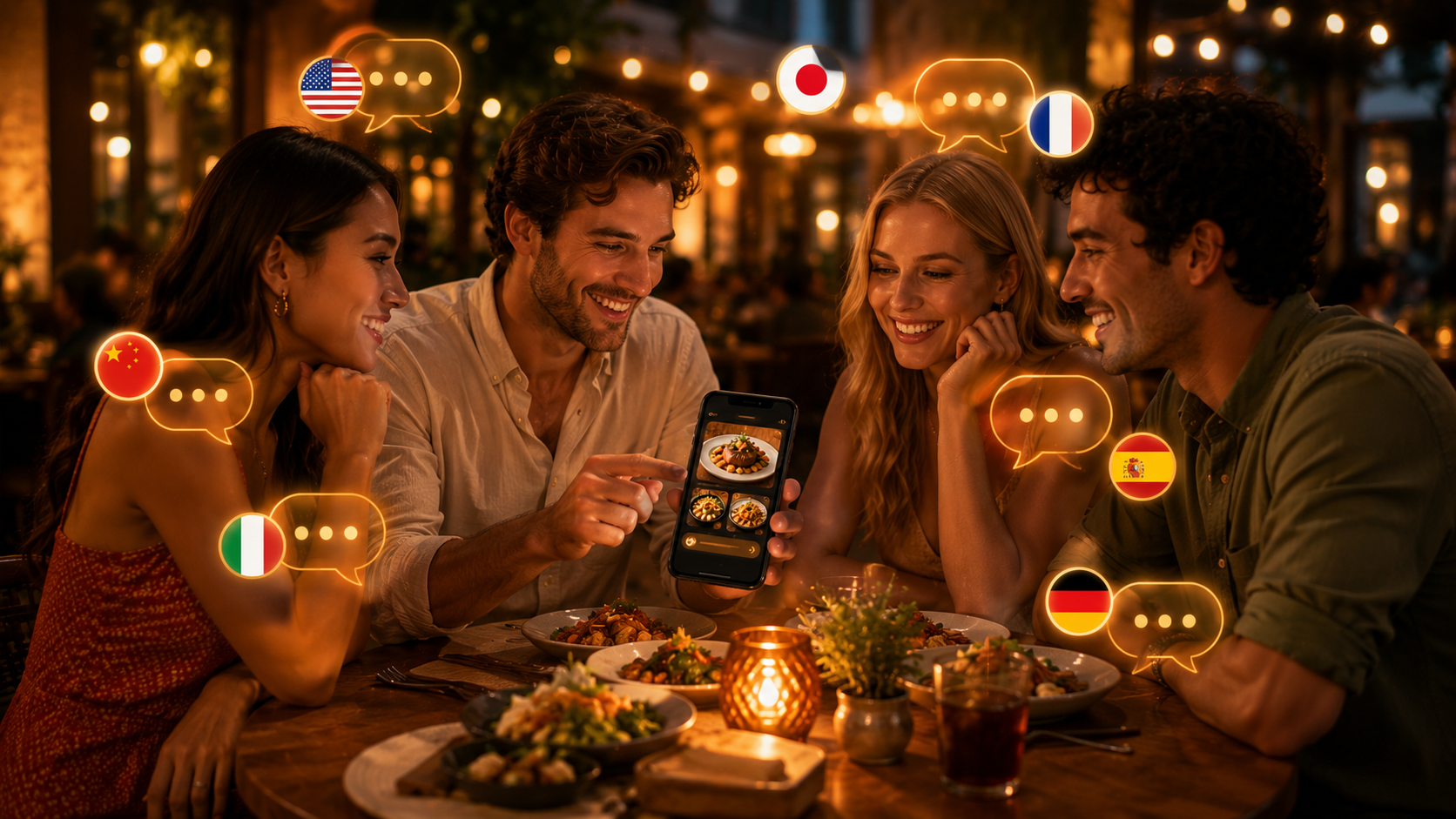
The Quiet Revenue Leak Nobody Talks About
A Japanese couple walks into your restaurant. They sit down, scan the QR code, and see a menu in a language they cannot read. They squint at the descriptions. They recognise the word "chicken." They order chicken. They eat it. They leave a small tip and a three-star review that says "food was fine." They do not come back. They do not recommend you to the twelve people in their travel group.
Now imagine the same couple scans your QR code and the menu loads in Japanese. They read every description. They ask the AI assistant "what is the most popular dish tonight?" and get a specific answer. They order the lamb — your highest-margin dish — plus a starter, two glasses of wine, and a dessert. They leave a five-star review. They tell their group. Four more tables follow over the next two days.
The food was identical. The kitchen did not change. The staff did not speak Japanese. The only difference was what happened in the two minutes between sitting down and ordering.
How Big Is the Language Problem, Really?
International tourism is one of the largest and most consistent sources of high-spending guests for restaurants in cities, coastal areas, historic towns, and anywhere near a landmark or transport hub. These guests typically spend more per cover than locals — they are on holiday, they are not watching their budget the way they do at home, and they actively want to try local food.
But language stands between their appetite and your revenue. A tourist who cannot understand your menu will not take a risk on something unfamiliar. They will order something recognisable and safe — which is rarely your most interesting or most profitable dish. They will skip starters and desserts because they cannot evaluate them. They will not ask for a wine pairing because they cannot frame the question.
Every one of those missed choices is revenue that evaporated silently. You never see it on your reports. You just see a lower-than-average check from a table that should have been one of your best.
The Two Directions of the Language Problem
Most restaurant owners think about the language barrier in one direction only: foreign tourists who cannot read the local menu. But the problem runs both ways.
Direction 1 — The tourist at a local restaurant. A Russian family visiting Yerevan, a French couple in Istanbul, an American group in Tokyo. They want to eat local food — that is part of why they travelled. But the menu is in Armenian, Turkish, or Japanese and they cannot navigate it without help. They default to what they know and leave having missed the best of what you offer.
Direction 2 — The local at an international restaurant. An Armenian family visits a Japanese restaurant in their own city. The menu has sushi names transliterated from Japanese, category names they do not recognise, and preparation methods they have never encountered. They are curious but lost. They order a California roll because it is the one thing they have heard of and leave without discovering that the omakase tasting menu would have been the experience of their month.
In both cases the guest wanted to engage but the menu made it too hard. An AI-powered multilingual menu removes that friction in both directions simultaneously.
What a Multilingual AI Menu Actually Does
A multilingual QR menu is not a translated PDF. It is a live, interactive menu that adapts to each guest individually. Here is what that looks like in practice:
- Automatic language detection. The menu reads the guest's device language setting and loads in that language automatically. A guest from Germany gets German. A guest from Russia gets Russian. A guest from Brazil gets Portuguese. No language selector to find, no extra step, no friction.
- AI questions in any language. The guest types a question in their own language — "what is the difference between these two dishes?", "does this contain nuts?", "what would you recommend for someone who likes spicy food?" — and the AI answers in the same language, drawing from the actual menu data. The kitchen does not need to know the question was asked. The server does not need to be involved.
- Dish descriptions that actually sell. A translated description is not just a transliteration. On Qrave, descriptions are written or reviewed for each language, meaning a French guest reads text crafted for how French speakers think about food — not a machine-translated version of the English that reads as awkward in every language.
- Allergen and dietary information in the guest's language. This is particularly important for international guests, who may have dietary requirements rooted in religious practice, medical need, or personal preference, and who face a double barrier: not only do they need to find the right dish, they need to confirm it is safe in a language they understand.
Real Scenarios Where This Changes the Outcome
The solo business traveller. A Korean executive has two hours between meetings. She sits at the nearest restaurant, scans the menu, and it loads in Korean. She asks the AI "what can I eat in under 45 minutes that is not too heavy?" She gets a specific recommendation. She orders it, adds a coffee, finishes in 40 minutes, and leaves a five-star review on Google Maps — in Korean, visible to every Korean tourist who searches for restaurants in your city.
The tour group. A group of 18 Spanish tourists arrives at a restaurant near a cultural site. They speak almost no English. With a QR menu in Spanish, every guest browses independently. Three people with dietary restrictions find suitable dishes without involving the server. The group orders two rounds of drinks, multiple starters to share, and four desserts. The server's only job is to bring food and collect payment.
The curious local. An Armenian couple visits a new Korean restaurant in their city. They have never eaten Korean food. The AI assistant explains what bibimbap is, what the difference between galbi and bulgogi is, and suggests a good combination for two people trying the cuisine for the first time. They leave having ordered adventurously and confidently. They bring friends the following week.
Why This Is a Competitive Advantage, Not Just a Feature
Most restaurants in tourist areas still have menus in one language, occasionally two. The ones that add a third and fourth language typically do it with a printed insert that is out of date, incomplete, and formatted for paper rather than a phone screen.
A restaurant with a fully functional AI-powered menu in eight languages — available on every guest's phone, responsive to questions, current in real time — is not just marginally better. It is in a different category entirely. For international guests who search for restaurants on Google Maps or TripAdvisor, a single review that says "menu available in Japanese and the AI assistant answered all our questions" is a signal that your restaurant actively welcomes international guests. That signal compounds: it attracts more international guests, generates more reviews in more languages, and improves your visibility in search results across multiple markets.
The Staff Equation
Hiring multilingual staff is expensive, unreliable, and impractical for most restaurants. You cannot have a Japanese-speaking server on shift every time a Japanese guest might arrive. Even if you could, no individual server can handle questions in twelve languages simultaneously.
An AI menu assistant handles every language simultaneously, at every table, at every moment of service, without a staffing cost attached to it. Your existing team focuses on delivering the food and creating the atmosphere. The AI handles the information layer that previously required either multilingual staff or leaving guests to manage on their own.
Getting Started
On Qrave, adding a new language to your menu does not require rewriting your menu from scratch. You build your menu once in your primary language, and Qrave's translation tools help you extend it to additional languages — with your review at each stage to ensure the descriptions sound right, not just correct.
Start with the two or three languages most common among your international guests. Check your existing Google Maps reviews for the languages guests leave reviews in — that tells you exactly which markets are already finding you. Then add those languages to your QR menu and watch whether the guest experience, review quality, and average check from those guests improves.
It almost always does — because the guests were already there. They just needed a menu they could actually read.
Start a free 14-day trial on Qrave and add your first additional language before the end of the week.