How to Increase Restaurant Revenue Per Table Without Hiring More Staff
Labour is your biggest cost and your hardest constraint. Here is how smart restaurateurs are growing revenue per table by changing what happens before the order — not who takes it.
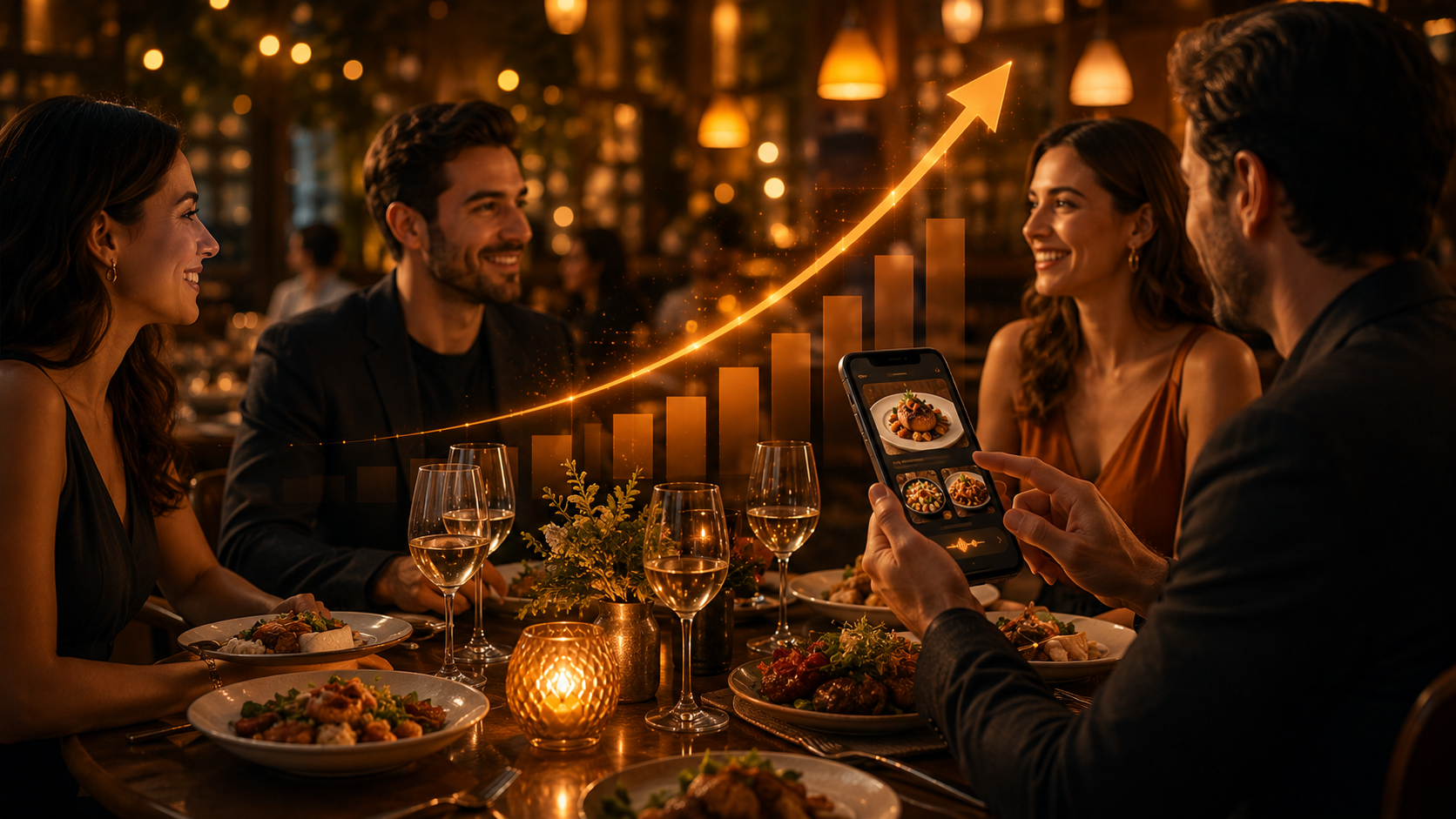
The Revenue Per Table Problem
Every seat in your restaurant has a ceiling. There are only so many covers per shift and only so many hours in a service. If you want to grow revenue without opening a second location or extending your hours, you have essentially three levers: turn tables faster, increase the average check, or fill more seats. Most operators focus on the third — marketing, social media, discounts — and neglect the first two entirely.
The first two are where the real money is. And they are both heavily influenced by something most restaurateurs have not thought of as a revenue tool: the menu itself.
The Moment Before the Order Is Worth More Than You Think
Between a guest sitting down and placing their order, a decision process happens that determines your revenue for that cover. What they look at, how long they browse, what catches their eye, whether they feel confident about a dish, whether they add a starter or a second drink — all of this is shaped by the quality of the menu experience.
A paper menu is passive. It shows the same information to every guest in the same way regardless of who they are, what they like, or what they have already looked at. A digital menu with AI is active. It responds. It answers. It guides. And that difference translates directly into euros on the check.
1. High-Quality Photos Add 25–30% to Individual Dish Order Rates
This is one of the most consistently replicated findings in menu psychology. A dish with a high-quality photo next to it gets ordered 25–30% more often than the same dish described in text alone. On a printed menu, adding photos means a redesign and a reprint — expensive, slow, and fixed once done. On a QR menu, you add a photo to any dish in under two minutes.
Start with your highest-margin items. If your lamb shank has a €14 contribution margin and you sell it 40 times a week, a 25% increase in its order rate is worth roughly €140 extra per week — from a single photo. Multiply that across five high-margin dishes and you have a meaningful revenue increase from an afternoon of food photography.
2. The AI Assistant Upsells Naturally — Without Awkward Table-Side Scripts
Training staff to upsell is expensive, inconsistent, and often uncomfortable for both the server and the guest. A server who has been on their feet for five hours at the end of a Saturday night service is not going to deliver a warm, confident recommendation about the wine pairing for the sea bass.
An AI menu assistant does not get tired. When a guest asks "what goes well with this?" the AI responds instantly with an accurate, on-brand suggestion — the specific wine on your list that pairs with that dish, the starter that complements the main they are considering, the dessert that is worth saving room for. It is upselling without the pressure, which means guests receive it as helpful rather than pushy.
Restaurants using AI menu assistants consistently report higher attachment rates on starters, sides, and drinks — not because guests are pressured, but because the question "what should I add?" now has a good answer available at the exact moment the guest is making decisions.
3. Dietary-Restricted Guests Order More When They Feel Safe
A guest with a gluten intolerance at a restaurant with no dietary labelling does one of three things: they order something obviously safe and boring, they ask the server repeatedly and feel like a burden, or they under-order because they are not sure what they can eat. None of these outcomes is good for your revenue or their experience.
On a QR menu with allergen filtering, the same guest filters by gluten-free and sees eight dishes they can order confidently. They browse all eight. They pick the one that sounds most appealing — which is usually not the cheapest option. They add a starter because they can see it is safe. They order dessert because the menu told them which ones are suitable.
Guests who feel safe spend more. The filtering feature that looks like a compliance tool is also a revenue driver.
4. Reducing Ordering Friction Speeds Up Table Turns
Every minute a guest spends waiting — for the menu, for the server to explain a dish, for an allergen question to be answered — is a minute that could belong to the next cover. A QR menu eliminates the first wait entirely: the menu is available the moment the guest sits down, before a server has visited the table.
When guests can browse, decide, and even flag their order before the server arrives, the service flow accelerates. The server's first visit becomes confirmation and relationship-building rather than information transfer. Tables turn faster without feeling rushed — because the guest was ready, not hurried.
In a busy service with ten tables, shaving eight minutes off the average cover time creates enough capacity for one extra table turn per service. At an average check of €35, that is €350 per service in recovered revenue — without a single additional staff member.
5. Real-Time Specials Push High-Margin Items at the Right Moment
A daily special is only valuable if guests see it. On a paper menu, specials require either a separate insert (which gets lost), a chalkboard (which the guest at table 12 cannot read), or a verbal announcement from the server (which gets forgotten by the time they order).
On a QR menu, the daily special appears at the top of the relevant category with a badge, a photo, and a description. Every guest who scans sees it. You can push a high-margin item — the dish with the best contribution margin that day, whatever the kitchen needs to move — to maximum visibility in thirty seconds.
This matters most at the end of a service when the kitchen has product to use and the team is stretched. The menu does the selling while the staff focus on delivery.
What This Looks Like in Practice
A restaurant with 60 covers per service and an average check of €32 is generating €1,920 per service. Applying the changes above:
- Photos on high-margin dishes increase their order rate by 25% → average check rises to approximately €34.50
- AI assistant improves starter and drink attachment → average check rises to approximately €36
- Faster table turns add one extra cover per service → additional €36
- Daily specials push the highest-margin dish → mix shift worth approximately €1.50 per cover
Conservative total: from €1,920 to approximately €2,250 per service. That is a 17% revenue increase from the same number of tables, the same team, and the same hours — driven entirely by what happens in the two minutes between a guest sitting down and placing their order.
The Investment Required
A QR menu platform with AI assistant costs a fraction of a single extra staff member. On Qrave, every feature described above — photos, AI assistant, allergen filtering, real-time specials, analytics — is included in a single monthly plan. There is no hardware to install, no app for guests to download, and no retraining required for staff.
The ROI calculation is straightforward: if the changes above add €300 per service and you run five services per week, that is €1,500 per week in additional revenue. The platform cost is recovered in the first day of the first week.
Start a free 14-day trial on Qrave — no credit card required. See the difference in your first service.